Friday, September 1, 2023

Coping With Negative Reviews

Every author will get reviews they don’t like on their published work. It’s just a fact of life: not everyone who reads your book will love it, like it, or even understand it. Some reviewers may have criticisms of your book that make sense; some will use their review to take out their bad mood on you; some will say lovely things.

​It is, of course, always okay to skip reading any or all of your reviews. Your job is to get all the critique you need before your book is published. If the negativity of 1-, 2-, and 3-star reviews isn’t going to help you, you don’t need to read them. If you still want to be motivated by the positive reviews, ask a friend or family member to filter them for you and skip the pain. But for those of you who are going to go ahead and read all your reviews anyway . . .

I’d like to discuss how to read reviews and especially negative reviews.


IDENTIFYING THE TYPE OF REVIEW

The first step, when you read any review, is to identify what sort of review it is. (I say “any” review here, because even a positive review can make you feel bad if it’s positive for the wrong reasons—for example, because the reader put their own false interpretation on your book. The reader may have loved your book, but it can be very frustrating for you as a writer if you wrote a book all about the joys of fishing, and your 5-star review tells other potential readers that the book is really a deep allegory about grief!)

The basic types of remarks in reviews are:

1. The Personal Remark

2. Illegitimate Feedback

3. Legitimate Feedback


THE PERSONAL REMARK

This one is usually quite mean-spirited. A personal remark in a review is any remark that, instead of reviewing the book, talks about the writer—also known as an ad hominem attack. Any comment like, “it’s obvious no one bothered to edit this book” or “the author clearly didn’t do any research” or “I don’t know if this book is so bad because you thought the reader was stupid or because you were too arrogant and lazy, but . . .”

Whatever the case—using passive voice, third person, or second person—the reviewer is making a direct attack and sometimes an outright libelous assault on the author. You can always click the Abuse button on Amazon reviews, but Amazon won’t always get rid of the review.

So what to do? Reviews like this do have a negative effect in that they bring down your overall star rating. Not to mention that it feels horrible for a total stranger to make personal (and almost invariably untrue) statements about you in a public forum! But if it helps: this sort of review typically doesn’t actually have anything to do with you—it’s all about the nastiness in the reviewer’s own brain. Any sensible human you want reading your book will recognize that the reviewer is just being a jerk and disregard their review.

It can be hard, but your best bet is to roll your eyes, understand this sort of nastiness is a reflection on the reviewer rather than you, and hit the Abuse button. It’s not worth any more mental energy than that, so try to have a good rant (in PRIVATE! Not on social media!) and then return to reading nice reviews instead.


THE ILLEGITIMATE FEEDBACK

When you’re reading reviews, ask yourself:

-    Does this reader understand my genre and subgenre?

-    Is the content of this review relevant to my book?

If the answer to either of these questions is “no,” then you are probably looking at illegitimate feedback. I’ll give an example of both, using Harry Potter:

EXAMPLE 1: “This book is ridiculous. It uses all sorts of creatures that aren’t even real. Why would a castle have moving staircases? Why would the pictures act like they’re alive?

In this case, the reviewer is saying “this book is bad because this book is fantasy, and I don’t understand fantasy.” Frankly, they had no business reviewing the book in the first place. The feedback is not appropriate.

EXAMPLE 2: “Heavy emphasis is put in this book on the effects that abuse had on the main character. Harry’s entire personality is formed by his abusive relationship with the people who raised him.”

In this case, the reader is simply wrong. Harry’s family was abusive, but the impacts of abuse are (in his case) almost entirely ignored in the books. The reviewer appears either to have very poor reading comprehension or to be putting their own assumptions on the book. This sort of bizarrely false reading is sadly not uncommon among reviewers, for both positive and negative reviews, and especially for books that evoke strong reactions.

Now, if multiple of your reviewers misinterpret your book in a similar way, then you should take that as feedback that you aren’t communicating clearly and need to be more explicit in your explanations. Talk to your critiquers and editors about this for your next book. But if it’s just one person saying one weird thing about your book . . .

Ignore it. People have their assumptions. It’s frustrating that the review is misleading the reader, but there’s simply nothing you can do about it, and it’s not your fault. This again reflects them, not you. You’re safe to ignore them.


THE LEGITIMATE FEEDBACK

Positive and negative!

I said in Illegitimate Feedback that if multiple reviewers are saying the same wrong thing (or different wrong things about the same topic), then you should take that as feedback that you aren’t communicating well. Other than that, ask yourself the same questions as before. If the reviewer clearly understands your genre and your book, then you can consider their feedback to be actual feedback.

Now, as with any critique, just because one person says one thing doesn’t mean you have to change your writing. However, it is a good idea to consider all legitimate feedback and understand why it was given, so you can improve your writing. Ask yourself:

-  What do readers particularly like? Are there commonalities in the compliments I receive?

-   What do readers particularly dislike? Are there multiple legitimate reviewers saying negative things about the same aspect of my writing?

-    How are readers interpreting things in ways I may not have thought about, but which still demonstrate that they understand my story? For example, do they point out themes that I included without even realizing it?


NOW GO BACK AND REREAD THE POSITIVE REVIEWS SOME MORE

Let them motivate you and make up for some of the criticism! Getting negative reviews is rough, but there are also people who love your book. They’re your readers, the ones you write for, and your core audience. They matter the most, so go bask in their praise! You’ve earned it.

Write on!

 (First posted on the Thinklings Books blog here)

Sunday, August 6, 2023

Writing A Message: a Spoilery Review of How the Barbie Movie Shot Itself in the Foot

 I’d like to preface this review by saying that I AM the target audience for Barbie.  I’m a 35-year-old woman who played with Barbies as a child, and I have two nieces who are the right age for me to buy Barbies for.  I was eager to see Barbie, and I went with a friend who was also eager to see it.  I was even willing to wear pink, except I don’t have a movie-theater-appropriate pink outfit.  I like seeing fun dumb movies in the theater, and I like both of the lead actors.  I went intending to thoroughly enjoy myself, and indeed, I did thoroughly enjoy the first two acts and bits of the third.

But the movie also left me dissatisfied.  This was partly because the third act didn’t have enough material, which made its pacing a slog.  But mostly, my problem was with the message: I can’t stop thinking about how epically the movie screwed it up.  So I’m going to share my thoughts with all of you.


NOTE: I am not attempting to express what my politics may or may not be in this essay.  This is about the Barbie movie's message and how it failed to convey it.


THE STORY

Act One: Stereotypical Barbie has a perfect life where every day is the best day ever.  On the other hand, the Ken who was designed to be her boyfriend (Stereotypical Ken), is unhappy.  All he wants is Barbie’s attention, but she largely ignores him, and he becomes jealous when she pays attention to other Kens.  In Barbieland, Barbies hold all the jobs and all the power, and Kens are relegated to standing around hoping for Barbie attention.

Then one day, things start going wrong for Barbie: she starts having thoughts of death, her feet go flat, and she develops cellulite.  After consulting with Weird Barbie (the Barbie who’s been played with too much and so has chopped-off hair and Sharpie on her face), Barbie learns that the way to solve her problems is to find the girl who’s playing with her in the Real World.  Prodded by the Ken he’s most jealous of and desperate for the attention of the woman he loves, Stereotypical Ken sneaks in the back of Barbie’s car when she leaves for the Real World.  When Barbie realizes he’s come along, she expresses her disdain for him but lets him stay.


Act Two: Barbie and Ken enter the Real World.  There, Barbie discovers that some of the jobs she associates only with females are held by men, and some rude men wolf-whistle her.  On the other hand, Ken discovers that people actually have a tiny bit of respect for him in the Real World instead of completely automatically dismissing him because he’s male.  Eager to learn more, he goes to the library to research what this means.  Meanwhile, Barbie meets the girl she thinks is playing with her: a young teenager who immediately gives her a hateful, nasty little speech because she wants to make Barbie cry.  Mattel, the Barbie company, shows up soon after and takes Barbie in, intending to return her to Barbieland.  Finding Barbie gone, and excited by a world where men get some respect instead of being banned from all jobs and homes, Ken heads back to Barbieland alone to share what he’s learned. 

Feeling something is off in Mattel (where the boardroom is filled exclusively with men), Barbie escapes in an action sequence.  The boardroom’s secretary, a woman who happens to be the mother of the vile teenage girl we met earlier, pulls up in a car with her daughter and escapes with Barbie.  We learn this woman is the actual person who was playing with Barbie; she was using her to express her grief over her perceived victimhood due to her bratty daughter and womanhood.  Barbie, the secretary, and the horrible teen decide to go visit Barbieland together.


Act Three: the trio of women arrive in Barbieland, only to find it has been transformed into a kingdom of Kens.  For some reason, bringing the idea of male empowerment to Barbieland made all the Kens start dressing like dude-bro gangsters and brainwashed the Barbies into their adoring bimbo slaves. (??)  For the first time, Kens get to live in houses and do the things they like, instead of being repressed; and the Barbies have turned into Stepford wives.  Ken points out how unkind and unfair Barbie has been to him, and asks how she likes it to be treated as he’s been treated, but he clearly also still adores her and wants her approval.  Totally missing his point, Stereotypical Barbie collapses in despair, which prompts secretary and her vile teenage daughter to immediately abandon her and return to the Real World.  However, due to a chance encounter, they change their minds and return.

Back in Barbieland, secretary and vile teen meet up with Weird Barbie and a few discontinued Barbies, who have for some reason not been brainwashed.  Secretary goes off on a rant about how poor, downtrodden, and abused women are in the Real World, and how unfair life is, and for some reason this unbrainwashes the normal Barbie present.  (Which makes ZERO sense, because Barbies would have never experienced anything whatsoever that she talks about, since they have always been the oppressors and far worse than the Real-World men depicted in the movie.)  Secretary's rant is long and boring and then repeated during a heist sequence in which Barbies kidnap other Barbies and have them listen to this rant until they are all secretly unbrainwashed.

Now, Ken’s plan has been to hold an election and vote for Kens having power in Barbieland. Wanting to stop the Kens from gaining any power (and to keep Barbies having universal power), Barbies decide to stop any Kens from voting so that only Barbies get to vote.  The Barbies therefore run a romance scam in which they pretend to like their respective Kens, only to abandon them and make them jealous so that they fight West Side Story-style.  The Kens do, but then they reconcile and become friends, forgiving each other and showing some of the only real kindness in the entire movie.

In the meantime, the Barbies successfully vote that only Barbies can have power and Kens can have none, the Mattel boardroom men show up again for some reason (???), and the Kens are once again forced out of the Barbie dreamhomes and told they can do nothing but stand around decoratively.  The Barbies throw them a tiny bone saying maybe they can do something small once in a while.  Stereotypical Ken accepts his defeat graciously and expresses his love for Barbie.  She immediately rertorts that she doesn’t care about him at all or recognize that he has any worth and that he’d better go find himself and stay away from her.  She then decides she wants to be human for no reason, and leaves to live in the real world.


THE MESSAGE

Obviously, the intended message of the movie is, “Patriarchy is bad.  Women have it super rough and are victims of The System, which needs to change.”  That’s what characters say, over and over.  But actions speak louder than words, and do their actions convey?  Let’s look at our characters:


Barbie is vapid and silly.  She fails to recognize any value in Ken, who adores her, and purposefully ignores, manipulates, and spites him.  During the course of the movie, she experiences emotions like sadness over the fact that the world isn’t what she wants it to be, and that’s all the character growth she gets.  She begins as she ends: utterly self-absorbed and careless of others’ feelings.

Our two human characters—the secretary and the teenage daughter—are spiteful, vicious, self-righteous, rigid-minded jerks who are only happy when they get their way and only like people who agree with them on everything.

Ken is simple and dumb, but neither simplicity nor stupidity are vices; and he is also honest, consistent, caring, and forgiving.  He does his best even though he doesn’t understand exactly what he’s doing.  I would argue that he is the only empathetic and likeable character in the movie.


Now, ignoring what the movie says its message is, lets look at what it shows it message is.  Ahem: 

o   Kens are treated as second-class citizens.

o   A Ken discovers that life doesn’t have to be this way, and so leads a revolt using the only models he has available to him: how the Barbies act and what little he has managed to research about the Real World.

o   In response, the Barbies brutally emotionally manipulate the simple Kens in order to prevent them from voting.  Once victorious, Barbies trample Kens back down to their second-class citizen status, with a miniscule concession to make it go down easier; although by the way Barbie treats Ken, this is clearly lip-service only.

o   The Kens, having lost, bow their heads and say they’re okay with not being in charge and with returning to their second-class citizen status with zero power, freedom, right to own property, or respect.

o   This is presented as a happy ending.

Is the problem clear?  If not, replace “Kens” with “black people” and “Barbies” with “white people,” and see how easily that message goes down.

The makers of the movie are not saying, “patriarchy is bad”; they’re saying, “Instead of being the HAVE-LESSes, we want to be the HAVE-ALLs and to have the current HAVE-MOREs to be the HAVE-NOTHINGs.”  It is vile, selfish, spiteful, and vapid . . . exactly like the secretary and her daughter.  Not a great message.


FIXING THE MESSAGE

Let’s assume that the film-makers weren’t actually despicable and wanted their message to instead be, “women and men should be treated equally, and here are the problematic areas we need to improve.”  How could this have been done?

First, I think making the movie a musical would’ve been a good move.  It would’ve softened the secretary’s boring rant frustration into something more palatable: as is done by Ken’s song when he sings out his frustrations.  It would’ve also helped with the pacing, since the movie clearly didn’t have even enough material for its short run-time.

Second, Barbie needs to actually recognize Ken’s worth at the end in a way that’s more than lip-service.  Together, they need to acknowledge that one extreme is no happier than the other, and that they need to work together to develop a social climate that is healthy and beneficial for both Barbies and Kens.

Third, Stereotypical Barbie needs to stay in Barbieland to help develop an improved social climate instead of abandoning it for the Real World.  Aside from not working with any of her character development, personality, or world setup, the fact is that Barbie abandoning Barbieland shows that her actual objective is still selfish self-gratification: when things become unfavorable in any way, she immediately either despairs or abandons the situation for greener pastures.


IN CONCLUSION

I did enjoy 75% of the Barbie movie, and I’m not sorry I saw it.  I do think some of the people working on it recognized some of the problems with the message, since the voiceover tried to throw Kens a bone at the end and Ryan Gosling’s superb acting as Ken showed the character's true feelings regarding his unjust treatment, helping to undermine the toxic message of the filmmakers.  Overall, I think this movie a great pity: there is a lot about it that is really good, and the movie could have been a vastly enjoyable popcorn watch if not for the ugliness of its true message.

Message is what you show, not what you say!  So if you're writing a message, make sure it's what you intend . . . or at least acceptable to you.

Thursday, July 13, 2023

It's my job to be polite, not to agree with you. Please stop.

Why are people needlessly offensive?

I've more than once read a book that would've be very good, except that the author just couldn't help himself.  He just had to be offensive toward [insert group here].  The offensive line often had nothing to do with the rest of the book; it added nothing, and it made no sense in universe.  He just wanted to be nasty toward [insert group here], and didn't bother with the self-control or the self-reflection to see that all he'd be doing was insulting his own readership and thus lowering his own sales.  There is zero possibility that he'd be convincing anyone of his opinion with a throwaway line of slander.

I may have discussed that in an earlier post in more detail.  What actually brought it to mind here was a conversation I recently had with a customer.  Because my current day job is at least partly customer service, I spend large chunks of my day being Charming and Polite Because You Are [for these 30 seconds] the Most Interesting Person in the World to Me.

This sounds exaggerated and sarcastic, but it mostly isn't.  I like interacting with customers, chatting with them and learning new things; it certainly makes the day go faster.  And sure, there are always those rude people who spend the whole time looking at their phones and avoiding eye contact, but since they apparently don't see me as human, who cares?  Most people are absolutely lovely.

Now, this past Friday, a customer who is friendly and likeable came up to me and started up a conversation which led to me mentioning I write books.  As often happens when I say this, he immediately began telling me all about the book he was writing.  After the initial explanation of his premise, he paused and said maybe he shouldn't tell me the next part, because some people found it offensive.

"In that case," I said, "please don't tell me.  I would not like to think less of you."

Well, he said, maybe he would tell me.  He wanted to tell me.

"Please don't," I said.  "I'd be sad if it were offensive."

But he had the bit between his teeth and a captive audience, and so he told me.  And having listened to the idea he was excited about, my reaction was . . .

Yes, that is offensive, and now I think less of you.  You should have kept your mouth shut like I asked you to.

See, people seem to think that because I am polite and can't leave, I must agree with them and want to hear their opinions on inflammatory subjects.  I have more than once had to flatly tell customers I won't discuss politics with them, and they still continue on to state their full opinion on [inflammatory subject].  And it's not that I necessarily agree or disagree with them; both have happened.  But this is my job, I am stuck talking to you, and I am not willing to discuss politics with you, so please stop.  Stop when I ask you to stop.  Why won't you stop?  You aren't going to convince me into anything, but you'll definitely make me like you less because you are a) abusing the nature of our customer-service relationship and b) not respecting my request to not discuss these topics.

As for this customer with the offensive story idea . . . why did you think I wouldn't find that offensive?  Because I am always friendly and polite to you, when I have no other option?  I liked and respected you before.  Now, I shall never again be able to interact with you without remembering the way you're writing about [subject unworthy to be repeated].  By failing to restrain your indulgence, you have hurt yourself and your relationships.

And it was all so unnecessary.

Tuesday, May 9, 2023

I Was Obsessed with Peter


 That wasn’t always his actual name, of course, except that it was.  When I was in college in Scotland, I picked up my novel The Fifth Tunnel and was deeply disturbed to find that Peter was called Jason.  When had I changed his name to Jason?  I knew, absolutely knew, his name was Peter.  I considered emailing, but I couldn’t wait.  So I called home to Montana (paying $1.50 a minute for the international call) and had a family member search through my original handwritten notebooks and verify what I knew for absolutely certain, that his name should have been and originally was Peter.

 It wasn’t.  I had named him Jason in the earliest drafts, and Jason his name remained.

 I wrote The Fifth Tunnel when I was seventeen.  Peter appeared again in the book I wrote at nineteen, Swallowgate, except this time he was half of Lloyd and a bit of Greg and something of Flynn, and maybe a slice of Calder, as if I’d split one character into four in a strange attempt to deny that he was, at heart, a Peter.

 A year later, I wrote him a third time --

(except I wrote him more times than this, in unpublished novels: a college-aged version of him is the protagonist of the never-written The Art of Subliminal Messaging; he appears in halfway form in the written but unpublished (and since cannibalized) The Nightmare Children of Faerie, and in one of his truest forms (i.e., very similar to Jason) in partially written iterations of Protector by the Green Light)

-- But I digress.  He appeared one last final time in Logic’s Emporium of Stolen Memories, and this time he is actually named Peter.  He is a little older than in The Fifth Tunnel and Protector by the Green Light, but still extremely Peter-like.  And something about me actually, finally calling him Peter brought peace to me about the character, and I was able to let him go: I have never written him since.  I think.

 So who is Peter? 

 Peter is a couple of years older than our protagonist.  He is intelligent, proud, lean, and rather tall.  He can act or speak pompously, but he is not inherently pompous.  He thinks well of himself, and likes to enforce his superior age—in part because he has issues with jealousy and brittle self-esteem, including of the protagonist.  He wants to think himself superior, so it is hard for him when the protagonist has importance or abilities that he does not.  He has white skin and brown hair and a few freckles but not many, and he tends to wear glasses and dress very properly and neatly.  He prefers to respect authority and rules but has enough determination to break free of them and leave to go elsewhere if he feels doing so is the best decision -- though wherever he goes, he will then learn the new rules of and obey them.

 I have no idea where Peter came from.  I do not have brothers, and I did not know anyone like him.  More exaggerated versions of him exist in movies and books, sure—but he is unique from all of them.  He has his own developed character, for someone who generally has middling-to-minor roles (since I never actually wrote The Art of Subliminal Messaging).  But I could not rest until I gave him his proper name in a book.

 I wonder if he will ever return to another book of mine.  And when he does, how long it will take me to realize it's him.

Tuesday, April 25, 2023

I Love Good Notebooks

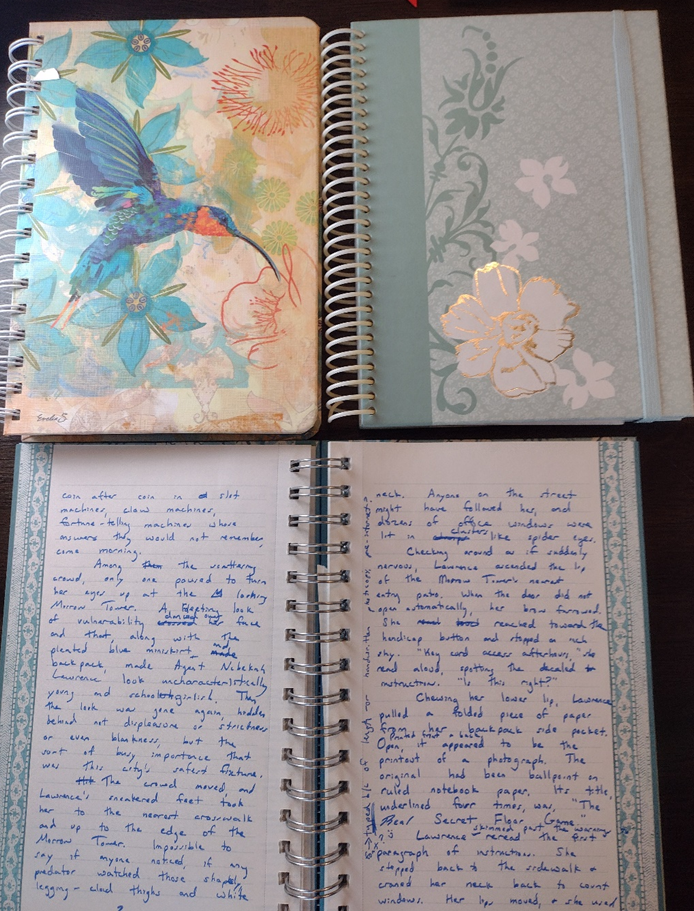
 I love good notebooks, and I’m very picky about them.  They need high-quality paper that even liquid ink won’t show through and hard covers that can survive being packed about.  They need to lie completely flat when open, and they need to be beautiful.  For thermal bound, they need to have a notebook and something to hold them closed.  At the moment, I have:


33 completely filled

27 not filled (but about half of them have some writing in them.

1 in progress (about 80% full)


So here are my recommendations, at a variety of price points!  I’ve listed them from cheapest to most expensive . . . but please note that that doesn’t reflect price efficiency. 


Picadilly.  I’ve traditionally bought these from Barnes and Noble for around $7.  There are many available at places like thriftbooks.com and ebay.  Decent quality for a low price point!


 Peter Pauper Press.  If you prefer thermal binding to spiral or wire-o but want to keep your price point low, this is a wonderful option.  They have many wonderful artists on their team, including some of my favorites.  Peter Pauper competes with much higher-end notebooks despite their price point being only about $8-$12.  I wrote The Land of the Purple Ring in Peter Pauper notebooks.


 My favorite, the Timeless Tree Journal


C.R. Gibson.   I’ve only gotten their spiral-bound notebooks, but they have a huge variety of stationery.  I like the fact that many of their notebooks have designs on the pages themselves.  And often a tint (rather than plain white).  They’re priced at about $7-15, which is pretty cheap for a high-quality notebook.


 Paperblanks.  Here our price-point jumps dramatically—for Paperblanks, you’re looking at $22-$35 per notebook.  However, the quality is also markedly higher.  For many years, Paperblanks was the standard against which I held outer notebooks.  They have designs on the edges, superb paper, and sturdy covers.  I own more Paperblanks notebooks than any other brand.


Official photo, so you can see a notebook similar to one I have with professional lighting:
Azure


 Notebook Therapy.  For smaller handwriting only!  Although these are the most expensive per notebook ($30-$40), they’re actually a better deal than most, because there are so many lines on each page and so many pages!  For example, you can see the one I’m currently writing in.  I get about 400 words per page, double what I get in most other notebooks.  By the time I’ve finished this one, I’ll have written almost 70,000 words in it over the course of more than five months.  The paper is white with bullet dots, which took some adjusting to, but the quality is fabulous and the edges colored.  Each notebook also comes in a beautiful box (I display them) with a matching paperclip.  Every notebook is limited-time only.  Really, the only possible downside to these is that dog hair sticks to the linen ones.


My photo doesn’t do justice to their beauty, so I’m also including this stock picture of the notebook I’m currently writing in (the one that’s open):


PENS

Pilot Fude-Makase

Pilot Varsity

Uni EMOTT

Staedtler triplus fineliner

Uniball Vision Elite


Wednesday, March 15, 2023

Where's the Sequel to Bargaining Power?

It has been about three-and-a-half years since my book Bargaining Power was published, and not only is the sequel not out, it is not written; and I have in the meantime published The Land of the Purple Ring and a season and a half of The Midnight Files.  So what gives?

You see, due to a number of factors, I strongly associate Bargaining Power with severe disappointment, despair, and betrayal from three separate sources.  Worse, two of those betrayals were predicted almost verbatim (seriously almost verbatim, without exaggeration: the people used almost identical phrases and fundamental outlooks, though the setups were different.  They were similar to the extent that I suspect my subconscious was preparing me for the inevitable) in Power Trips, one in Bargaining Power and one in the sequel.

The betrayal I inadvertently predicted in book 1 was bad; the one I predicted in book 2 was much, much worse, and I refuse to tell the story of it.  The person in question doesn’t deserve the attention.  Besides, I’m the sort of writer who writes out of love for a story, not one who throws all her dirty laundry at it, and I never write real people.**  Most importantly, I refuse to let the filth of ugly behavior influence the books I write to bring joy to others!  That was the heart of The Land of the Purple Ring and one of my greatest victories.  Not one of the painful, ugly, traumatizing things that happened to me in the months leading up to and overlapping the writing of it touched that book.  It remains unsullied.  Triumph!

Anyway, this philosophy of not writing real people and not bathing in filth leaves a problem, which is that the story of that second betrayal was fundamental to the structure of book 2.  That means that when I write book 2, I will have to start from scratch (other than the first two chapters, which will remain intact.  You can find them here).

Now, don’t get me wrong: it wasn’t like book 2 was finished; at most, it was a third done.  I had severe writer’s block and structural issues, which the intervening years have helped clear up.  I will definitely finish writing Power Trips eventually, probably as a duology.  But I cannot face it yet.  Even writing this brief post was painful.  And I know it is a mess, but I also figure that anyone reading it deserves an explanation for what is sure to be a long delay between books.


**Note: I never, ever base any characters off real people.  It is only afterwards that I sometimes notice the similarities of certain characters to certain people in my life.  But isn’t how that always is?  We none of us write in a void.

Second Note: ugly, traumatizing things are rare in my life, and betrayal rarer still.  I have many wonderful people in my life and am generally very happy.  It was just that for about two years there, things kept going horribly wrong.  But I got The Land of the Purple Ring out of it, so it was worth it in the end!

Thursday, February 23, 2023

I'd rather do it myself than let you cheat me

About two weeks ago, I took my car in for an oil change.  While there, the technician told me that it looked like I had a leak.  When pressed, she said it looked like it might be from the engine, but said she couldn't diagnose it.

Like a responsible car owner, I took my car into the mechanic.  Now, I don't think well of our local mechanic.  Last winter, I took my car in for a checkup and asked him to fix my AC.  "There was physical damage to the bumper that broke it," I said, "but the bumper has been fixed, so now the AC can be too."  When I got the car back, he told me that I'd been "out of AC fluid" and he'd "put more in so my AC would work."

Of course, it didn't work.  But I didn't press the issue; I just decided to go somewhere else next time.  I know of a good and honest mechanic about half an hour from where I live.  The problem is, I work Monday through Friday, my job is too far to walk during my lunch break, and I have a dog to care for.  I therefore reluctantly took my car back to the local mechanic.

"The oil engine pan is cracked," he said.  "There's another crack deeper, but that'd be really expensive to fix, and it's not bad yet.  So let's just replace the engine oil pan.  It'll be about $450.  You'll need to make an appointment."

I made an appointment for the following week and, in between that first visit and taking my car back, I found my windshield wiper fluid didn't work.*  I tried pouring more in, only for it to end up on my garage floor.  Now, I don't know anything about cars, but I'm perfectly capable of finding information online, and I watched a short YouTube video on diagnosing wiper fluid problems.  Conclusion: my washer fluid reservoir was cracked.  

I told the mechanic I thought so, when I brought my car back, and he confirmed it.  He also gave me my bill for the engine oil pan replacement: $500.  $50 more than the verbal quote.  That . . . didn't sit well.  For the work he did, $500 isn't unreasonable; it's about middle of the road.  But even if it was a verbal quote, I thought it very unprofessional to tack on 10%.

Still, I had to have washer fluid, as a safety measure, so I looked at the quote he gave me.  He told me, "It's going to be pricey, because Honda no longer makes your part, so I had to go for an aftermarket one."  And he quoted me $450 again.

$450.  For reference, the national average price to replace a washer fluid reservoir, including parts, is $145.  I looked it up, because $450 struck me as really, really high for what I thought must be a simple job.  And I already knew I couldn't trust him to stick to his quotes, it'd probably be even more.  Here is the breakdown he gave me (yes, I got it on paper this time):

Labor: $175
Reservoir: $189
Washer pump: $39
Freight: $35
Shop supplies: $14

Clearly, this absurd list called for more research.  First, I looked up how much time it would take him to do the job.  The answer is that the job is in fact extremely easy, and he could almost certainly finish in under 45 minutes.  Even if it took him an hour, that's $175/hour!  Mechanics, on average, charge $75-$130 an hour, and we've already established that he isn't that good at his job.

Second, the parts.  I found many places where I could order a reservoir and pump set that fit my car for under $40.  However, out of curiosity, I looked up the ones he said he was going to order.  He said on his quote he was getting them from Napa, so I looked up the actual cost on that website.  Here's what I found:

Reservoir: $115
+ Washer pump: $21
+ Freight: $0
- 15% for purchases over $100
TOTAL: $115.60
Mechanic's quote for the same supplies from the same supplier: $263

. . . 

Well, then.  Fine.  Be that way.  

I ordered the reservoir/pump set myself, for $32.  I don't think I can install it as quickly as he could, and it's horribly cold out, but I have a friend who's good at this sort of thing and says she'll help.

It's not that I couldn't take my car elsewhere.  It's that the mechanic tried to cheat me, presumably because he thought that my general ignorance of cars (and femininity) meant universal foolishness and incompetence, and that it was therefore acceptable to treat me in this fashion.  I can think of no better comeback than doing the repair myself.

--

* It's unlikely though not impossible that the mechanic broke it while doing his inspection.  Once you've demonstrated dishonesty, it's hard to trust you about anything.  If he didn't break it, that means that, while looking for a leak, he didn't bother to check the washer fluid reservoir.  Regarding this, he is therefore dishonest, incompetent, or both: he cannot be neither unless the reservoir broke during the week in between.  Which is even more improbable.

UPDATE: I installed the new reservoir and pump together with a friend.  When we took the bumper off, we found a) it hadn't been removed in years, and b) the reservoir itself (which the mechanic had told me was "completely shattered" was undamaged.  It was the hose which had broken, taking a tiny piece of the motor with it.  So the reservoir/motor/hose still needed to be replaced, and the parts I had bought were correct, but the mechanic flat-out lied to me.  Charming.